Clean the drawing and prepare 3D geometry
Open lactic-acid.vsk. This exercise keeps a specified stereocentre while separating 2D layout from 3D geometry. Use lactic-acid-3d.vsk to inspect the prepared result directly.
Move an atom with the selection tool so the drawing has an uneven bond. Click Clean up or press Ctrl/Cmd+Shift+L. Standard bond lengths and angles return while the molecule keeps its position and orientation.
Use Undo and Redo to compare. A molecule that cannot be cleaned without changing stereo is left as drawn with a warning; do not assume every molecule was changed just because the command completed.
Click Generate 3D in the Species heading for all missing geometries. Use Generate on an individual card for just that species. The lactic acid card should show a 12-atom structure, including hydrogens.
Redo replaces that species’ cached structure. Ordinary Generate keeps existing conformers. Editing the chemical identity, charge or multiplicity invalidates a geometry that no longer matches.
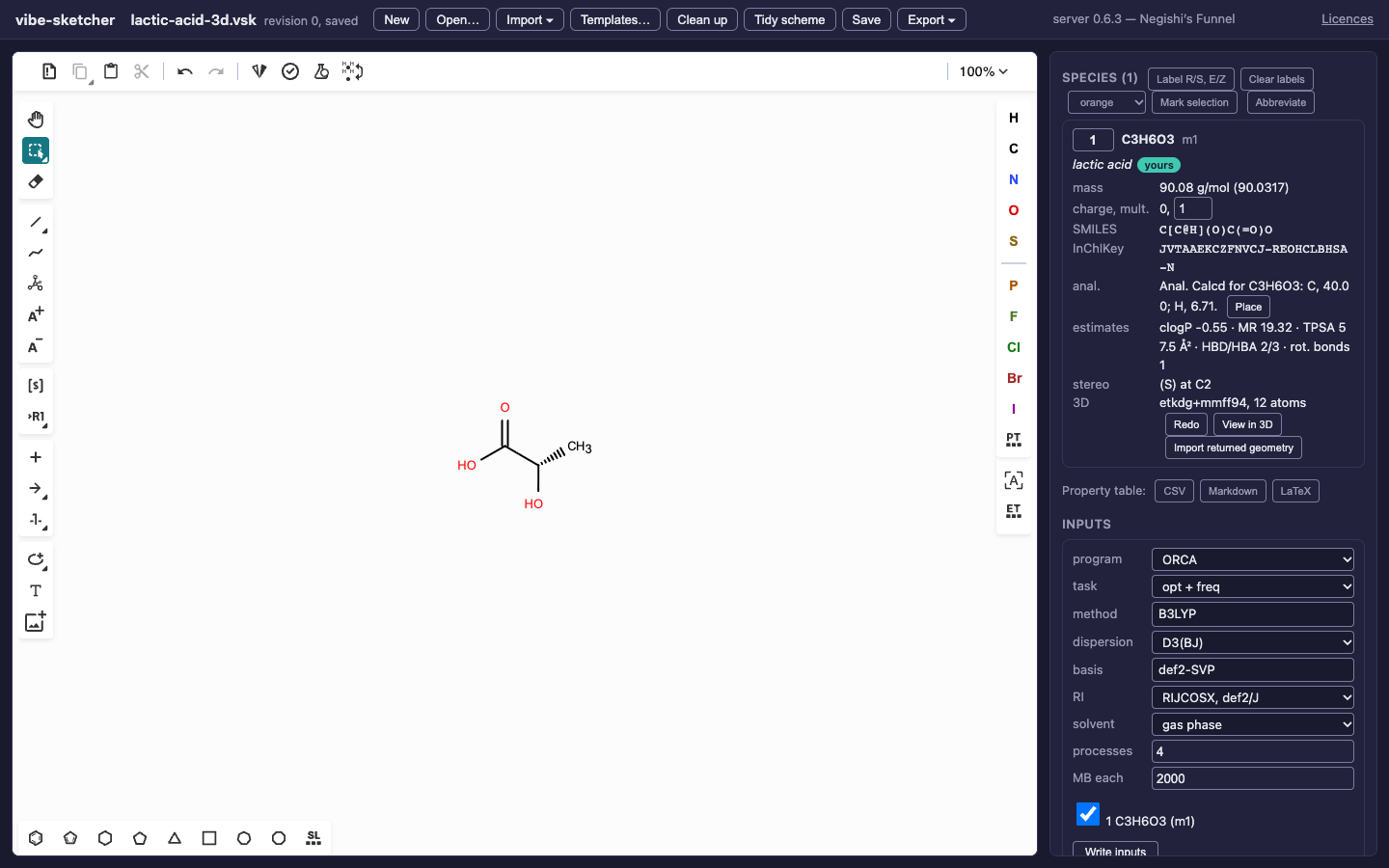
The geometry is an RDKit starting structure, not a completed vibe-qc optimisation.
The preparation uses ETKDG, followed by MMFF94 or UFF where available. Geometries without force-field coverage carry a warning. Specified R/S and E/Z must survive in 3D; unspecified centres are reported because embedding must choose coordinates. These checks do not establish conformational convergence or quantum-chemical accuracy.
Request several conformers through the CLI or API
vibe-sketcher clean lactic-acid.vsk -o lactic-clean.vsk
vibe-sketcher embed lactic-clean.vsk --count 3 -o lactic-acid-3d.vsk
vibe-sketcher embed lactic-acid-3d.vsk --species m1 --count 3 --replace -o redone.vsk
vibe-sketcher input redone.vsk --species m1 --program xyz --output-dir geometry
Use the real species ids from info. The count is between 1 and 20; pruning
can leave fewer distinct conformers than requested. Writers use the first
conformer, rather than generating a calculation for every conformer. When
force-field energies are available, generated conformers are ranked by that
energy; it is not a quantum-chemical energy or a comparison between different
species. Importing a geometry does not establish that it is a minimum.
--count does not add conformers to a species that already has them: ordinary
embedding keeps its cache. Use --replace deliberately to regenerate that
species, and save to a new file if you want to compare the old and new sets.
The example generator checks
stereo identity, cached geometry and explicit replacement and also writes
XYZ and QCSchema molecule files.
POST /api/chem/embed3d embeds an isolated SMILES and reports conformers,
force-field energies, open stereo and warnings without storing a document.
POST /api/documents/{id}/embed updates the shared document at its current
revision. The REST example exercises both.
For reference-guided 2D cleanup, FIRE-based relaxation and constraints, see cleanup and geometry. The reference source and supported force fields are documented there. Use vibe-viewer for detailed 3D structure editing, and vibe-qc inputs for a quantum optimisation.
ETKDG preparation retains the RDKit version, seed, attempted embeddings,
selected conformer, atom ordering, force-field termination codes and warnings
in each conformer’s source.relaxation record (kind: preparation). These
records survive document and QVF saving. A nonzero termination code remains
visible as unconverged even if coordinates were produced. Preparation is
never a verified quantum minimum; verified_quantum_minimum is false.
Atom maps in editable drawings
Native Ketcher atom-map numbers are preserved in the KET canvas and mapped
species SMILES, including import from mapped reaction SMILES or molfiles.
Save/reopen and QVF retain the canvas, species identifiers, reaction roles,
coefficients and preparation provenance. Added explicit hydrogens have map
number zero unless the input explicitly maps them. Each preparation records
atom_map_numbers in its explicit-H coordinate order. Changing drawn maps
keeps chemical/species identity but clears cached conformers whose canonical
ordering may have changed; generate 3D again before compiling.
The reaction mapping panel’s display highlights and temporary NEB pins are separate from native saved atom maps. A numerical map label is an annotation, not proof that a reaction mechanism or atom correspondence is correct.