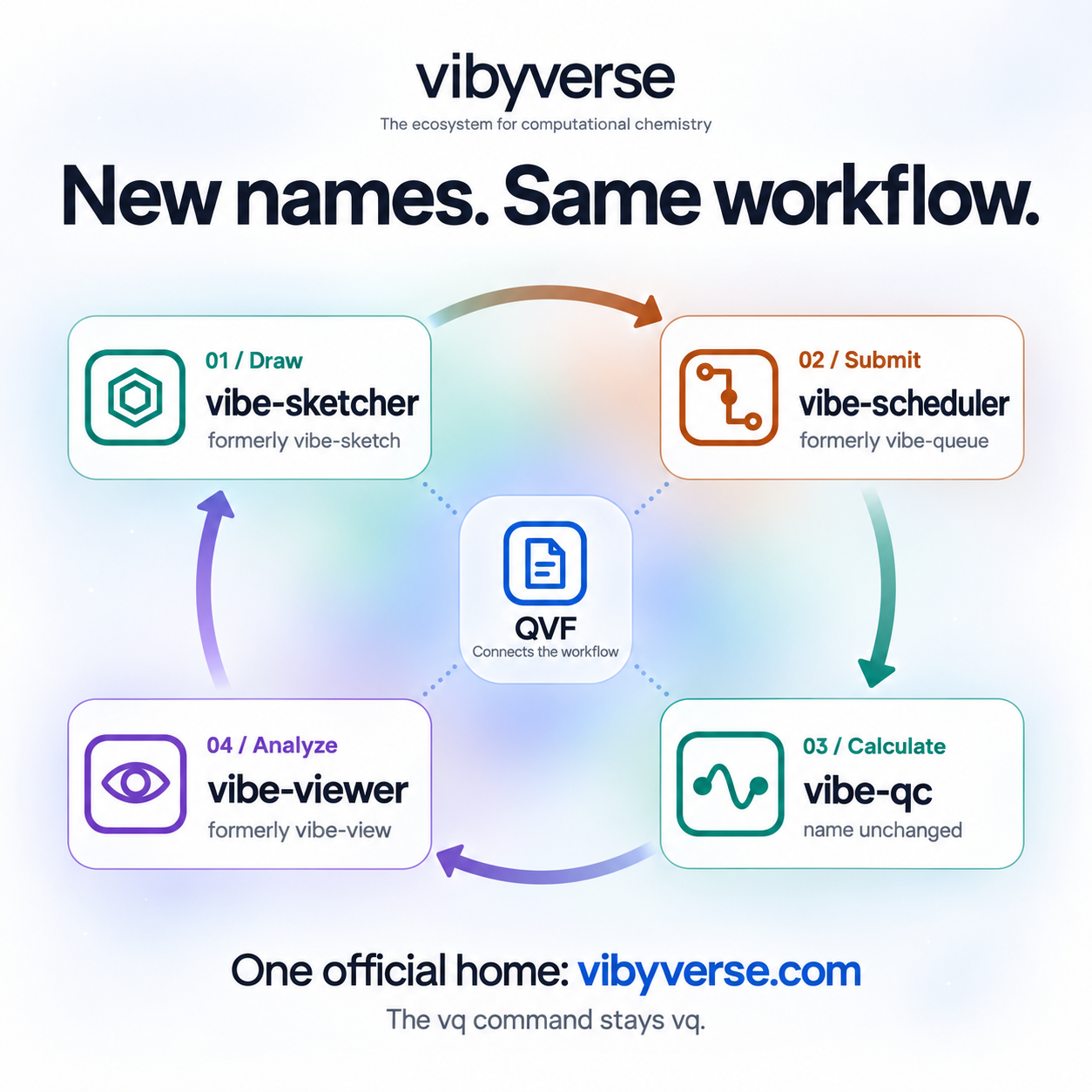
Since vibe-qc 0.19.0 (13 November), every Vibyverse app has shipped a new release:
- vibe-qc 0.19.2
- vibe-viewer 3.1.2
- vibe-sketcher 0.7.3
- vibe-scheduler 1.0.14
All are available now on the download page. In the same days we ran a long validation pass over the vibe-qc issue tracker. Eleven bug fixes were verified against independent calculations and closed; they are on main and ship with the next vibe-qc release. This post collects the highlights with the numbers behind them.
vibe-qc 0.19.1 and 0.19.2
- Continue a stopped SCF. initial_guess="read" now accepts the dump of a molecular SCF that stopped at max_iter and continues from the density where it stopped. The run states which density it used: "READ guess density" in the output, restart_density in the run record. A dump from another basis or with other dimensions is refused instead of being misread.
- Local triples you can trust. The (T1) occupied rotation of closed-shell DLPNO-CCSD(T) is now checked for convergence. Each step uses the exact annihilating angle, and a rotation that has not converged stops with a clear message instead of producing wrong (T) denominators. Converged results are unchanged to rounding.
- Open-shell DLPNO-UCCSD(T) with localized orbitals. For a localized source, the (T) step now transforms to the canonical basis of each spin. At complete PNO domains it reproduces canonical UCCSD(T) to rounding.
- Slab Coulomb profiles follow the basis set automatically: the z grid tracks the tightest primitive pair, and the padding tracks the most diffuse one. A def2-SVP Mg core now passes the profile self-check, and oversized slab tables are refused before they are allocated.
Verified on main, shipping in the next vibe-qc release
Symmetry reduction that pays off. A space-group-reduced (IBZ) Hartree–Fock calculation of rock-salt NaCl (def2-SVP, 4×4×4 mesh) used to stop at the starting guess. A check on symmetry-related k-point spectra also looked at virtual bands that never hold an electron, and roundoff there tripped it. The check now covers only levels the fill can occupy. The reduced and full calculations then agree to 2×10⁻¹³ Ha per cell:
- NaCl RHF/def2-SVP (4,4,4) on 16 cores. Energy: −621.3208438046753 Ha per cell (full mesh) and −621.3208438046755 Ha per cell (symmetry-reduced).
- Wall time: 6,979 s (full mesh) and 1,742 s (symmetry-reduced).
- Peak memory: 21.0 GB (full mesh) and 5.3 GB (symmetry-reduced).
That is about 4× less time, CPU and memory for the same answer.
Open-shell ROHF that actually converges. For the OH radical (def2-SVP), a core-Hamiltonian start used to swap the occupations of the degenerate π pair on every iteration, so it never converged. Even the default start "converged" to a state with a fixed-occupation gradient of 5×10⁻². The fractional shell is now relocked when the spectrum splits a degenerate set, and it uses occupation-weighted coupling. Dense and Davidson solvers both converge in 12 iterations to E = −75.5732171312 Ha, and the gradient is 6×10⁻¹¹. PySCF gives the same energy for the same density to 3×10⁻⁸ Ha. The same correction applies to multi-k periodic ROKS: for aluminium at Γ the gradient drops from 3×10⁻³ to 6×10⁻⁸, and the energy is 6.3 µHa lower.
A positive-definite solvation cavity. The point-charge CPCM/COSMO cavity matrix was indefinite: 5 negative eigenvalues for a methanol test case. Its charges could resonate as the geometry moved. The default Gaussian cavity has no negative eigenvalues (the smallest is +3.39), its finite-difference residual is 1.6×10⁻⁹, and PySCF reproduces the cavity matrix to 9×10⁻¹⁶.
A better Ewald Hartree term, opt-in for now. A new range-separated EWALD_3D Hartree (VIBEQC_J_EWALD3D_BACKEND=split) fixes the truncated core densities of the analytic-FT route:
- Water dimer, error against molecular RHF: −232 mHa with the old (analytic-FT) Hartree, −0.35 mHa with the split Hartree.
- Diamond (2,1,1), error against GDF: −32.5 mHa with the old (analytic-FT) Hartree, +0.27 mHa with the split Hartree.
- MgO, over-binding against converged reciprocal space: 1.03 Ha with the old (analytic-FT) Hartree; the split Hartree differs by 7×10⁻⁵ Ha.
Periodic local correlation. In the GDF route of DLPNO-CCSD(T), orbital centroids and differential-overlap screening now respect the periodic torus. For diamond, the periodic and molecular descriptions give the same CCSD and (T) energies to 2×10⁻¹³ Ha per cell, with identical domains and pair lists.
Plus: consistent operator support in the GPW gradients, stress and open-shell starting guesses, and native core builds checked on Linux with GCC.
vibe-viewer 3.1
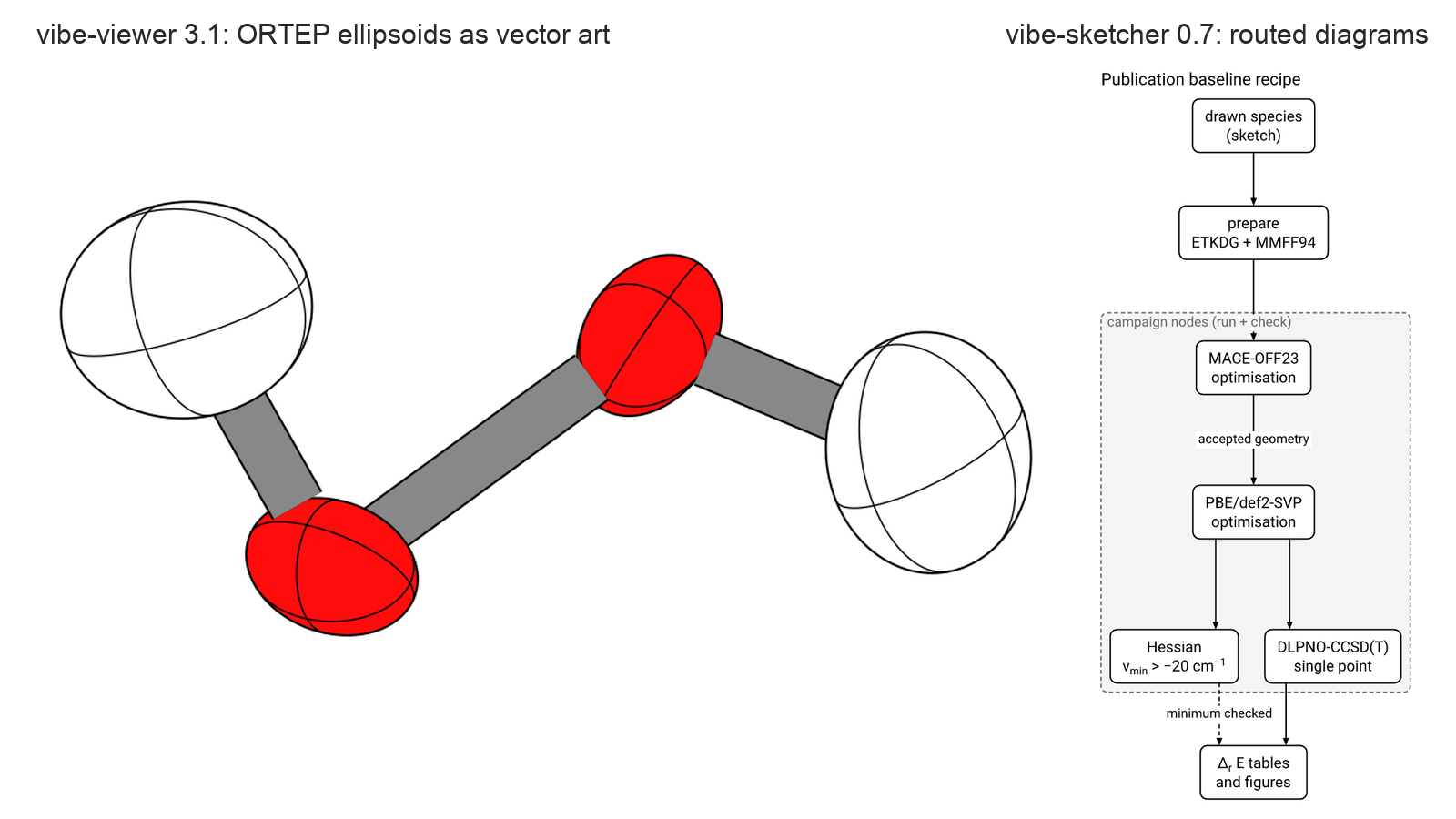
vibe-viewer capture … --adp-table adps.txt -o figure.svg now draws ORTEP-style displacement ellipsoids as exact vector line art, ready for a journal figure (header image, left: hydrogen peroxide with example displacement values).
- Publication figures without a screenshot: headless capture writes ellipsoids, coordination polyhedra and pore overlays (channels, cavities, Di/Df spheres) as SVG or PDF.
- New result types: energy-decomposition sections (QVF 0.8.0), Landauer transport T(E) and I(V), and X-ray absorption and emission spectra with their declared units. Mössbauer site parameters come with their reference and calibration.
- Crystal building: a cell editor for periodic a/b/c axes; framework construction with a different linker on each net edge; guest loading specified by mass, in mmol/g or wt%; calculated powder patterns with a Kα2 doublet and Caglioti peak widths.
- Fixes: periodic structures from vibe-sketcher keep their authored bonds and bond orders, and macOS desktop plots use the bundled fonts.
vibe-sketcher 0.7
Workflow diagrams can now route connectors orthogonally around boxes, and text can carry typeset math (ν_min, Δ_r E). Header image, right: the publication baseline recipe from the vibe-sketcher documentation.
- Solid-state building: symmetric tilt grain boundaries of cubic crystals as CSL bicrystals, with Σ and every tilt angle recorded; ordering of structures with disorder groups; a bond-graph editor that can import a CIF's bond table.
- Charged defects: formation energies can be planned and evaluated with the Ewald image-charge correction in the dielectric metric.
- Publication output: a stored physical page setup with page guides on the canvas; multipage vector PDF; typeset math in SVG, PDF, PNG, EPS and EMF.
vibe-scheduler 1.0.12–1.0.14
- Hosted sign-in can remember a private browser for 30 days. Sensitive changes still ask for the authenticator.
- Status reports now include build duration and compiler-cache hit rates.
- First immutable runtime generations build without pausing running jobs.
- Updates are verified more robustly: managed launchd readiness, exact source and digest checks, and rollouts that use only current component sources.
Download the new versions from the download page. The full changes are in each project's changelog.