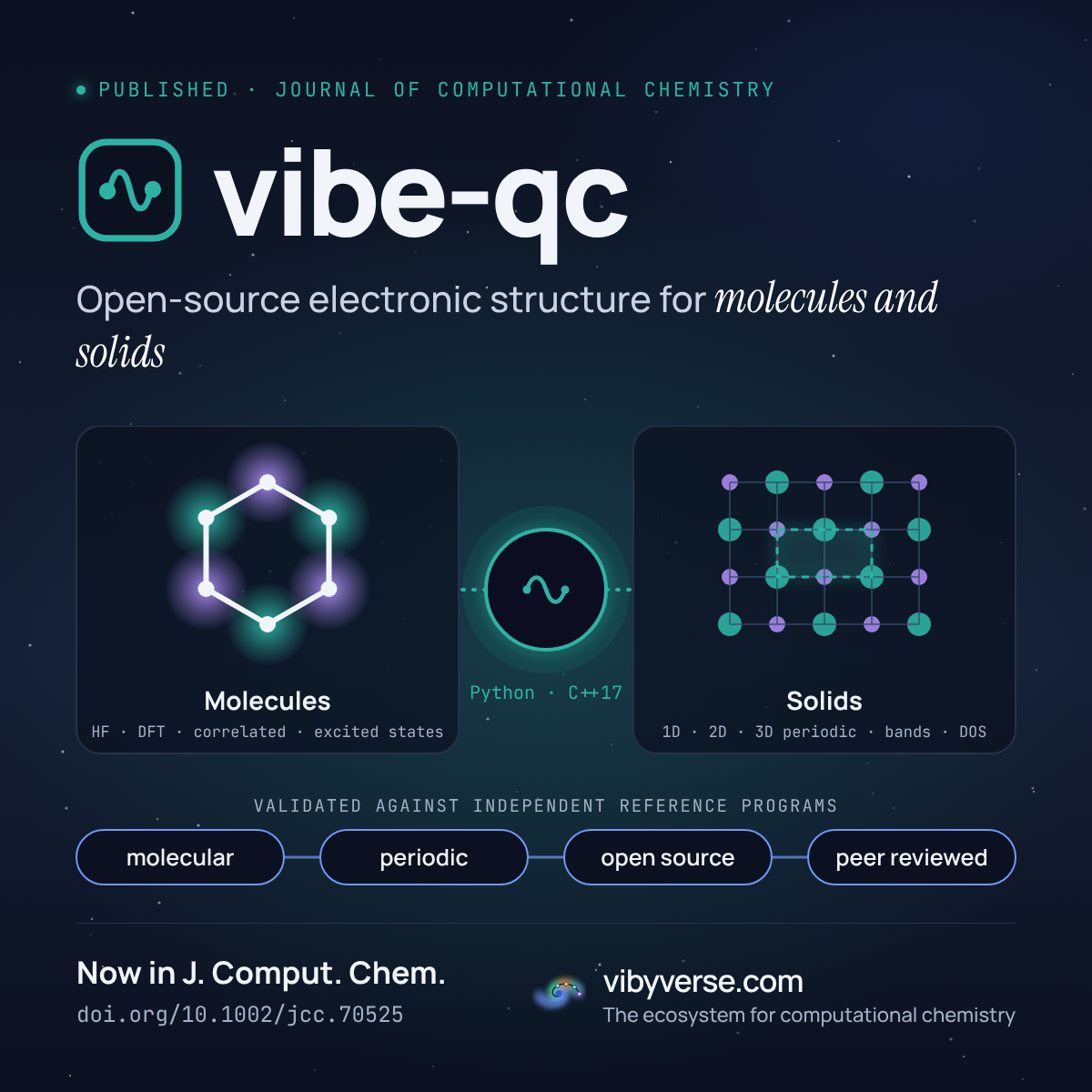
vibe-qc is now published in the Journal of Computational Chemistry
The vibe-qc paper, describing the electronic-structure engine of the vibyverse, is now published in the Journal of Computational Chemistry.
Open-source tools for drawing structures, running quantum-chemical calculations and analyzing the results, connected by a common data format.
 yx
Five independent projects, each with its own scope, that exchange data through QVF.
A chemical drawing tool developed by agentic engineering for structures, reactions, publication graphics, and calculation inputs.
A job manager developed by agentic engineering to submit, track, and retrieve command-line work across your laptop, remote machines over SSH, and configured PBS or Slurm clusters. Works with any command-line job, not only vibe-qc.
An electronic-structure engine developed by agentic engineering for molecules and periodic solids. It provides a Python interface and a C++ core; the documentation records method status and scientific limitations.
A visualization tool developed by agentic engineering for structures, orbitals, densities, and spectra from QVF archives and supported chemistry files. Work in a browser, on the desktop, in a terminal, or through Python.
The Quantum Visualization Format and its reference toolkit are developed by agentic engineering to keep structure, scientific data, and provenance in one shareable archive. The format is independent; the toolkit is Apache-2.0 licensed.
The four steps of a typical calculation and the tool for each.

 01 / Draw
Draw molecular structures and prepare calculation inputs with vibe-sketcher.

 02 / Submit
vibe-scheduler runs it locally, over SSH or on a PBS or Slurm cluster.

 03 / Calculate
Calculate electronic structure for molecules and periodic solids with vibe-qc.

 04 / Analyze
Visualize structures, orbitals, densities and spectra with vibe-viewer.


+ / ConnectQVF carries data between the steps. A shared format for scientific data and its context.
QVF specificationThe vibe-qc paper, describing the electronic-structure engine of the vibyverse, is now published in the Journal of Computational Chemistry.
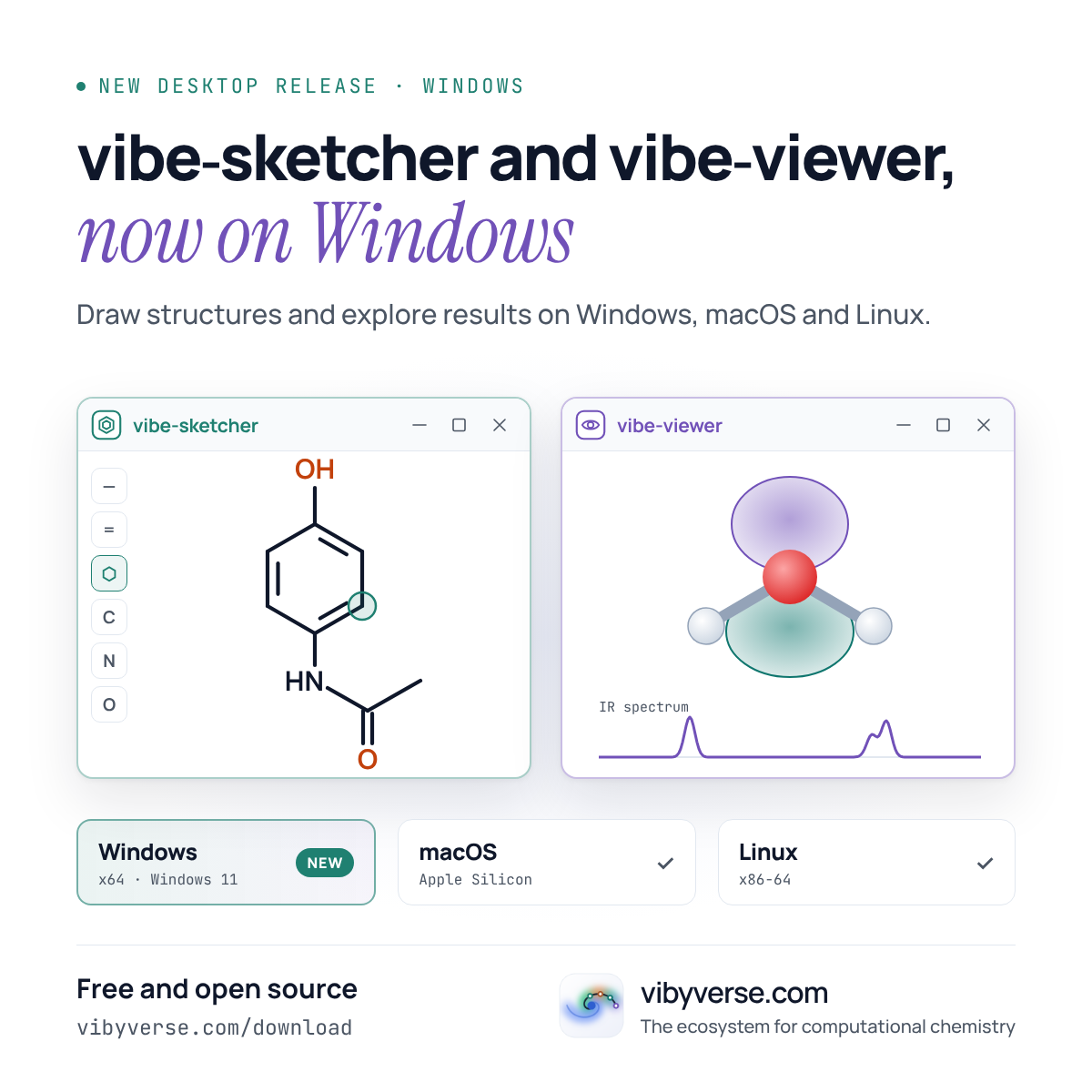
Windows x64 installers for vibe-sketcher and vibe-viewer are now on the download page, tested on Windows 11, alongside the macOS and Linux builds.
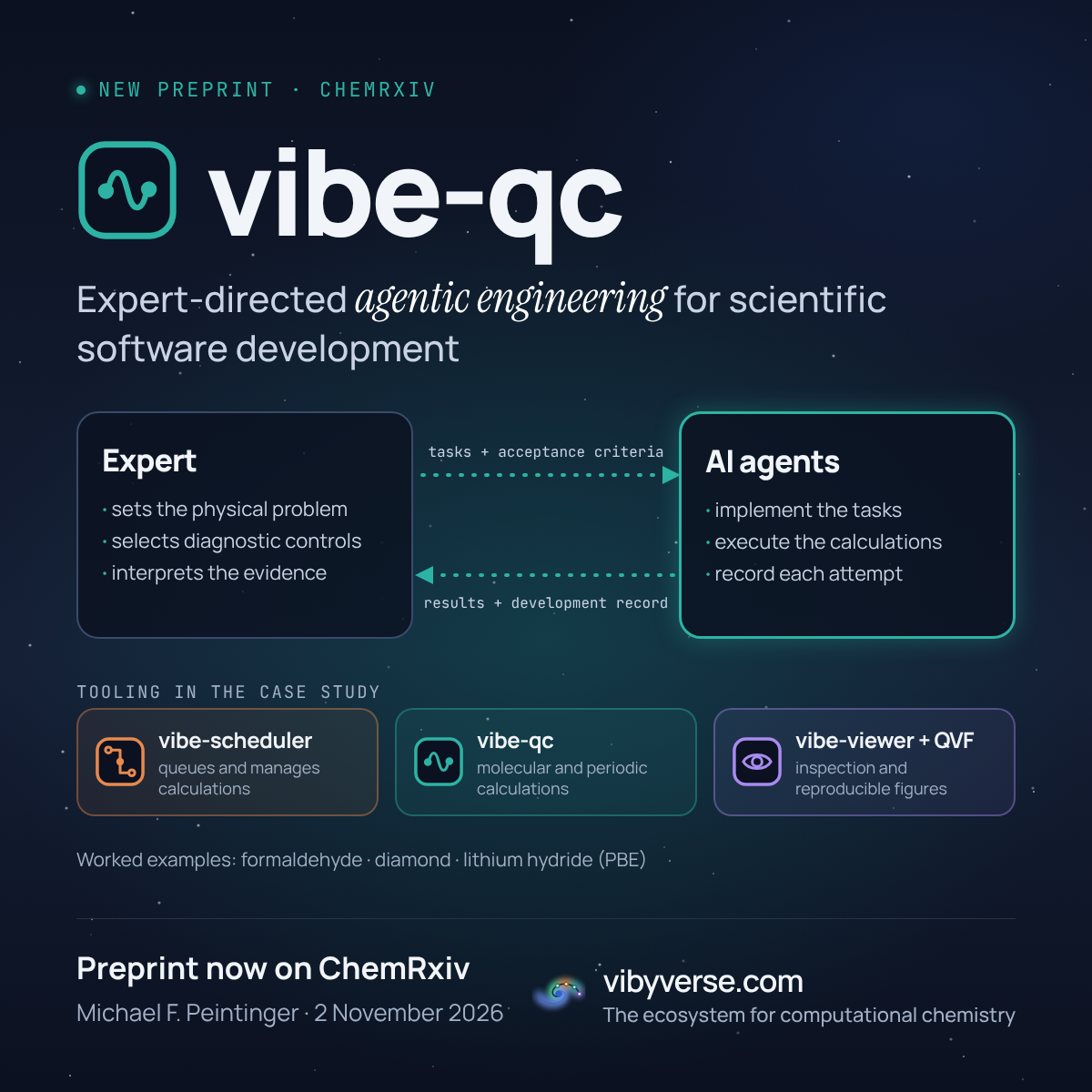
A case study of how vibe-qc is developed: the expert sets the problem and interprets the evidence, AI agents implement and execute, and the development records stay traceable.
Papers describing the tools, and selected work that cites them.
Explore publications & citations ↗

The vibyverse brings together quantum chemistry tools developed by agentic engineering under the scientific direction of Dr. Michael F. Peintinger.
Development, validation, documentation and maintenance take time and computing resources. Help sustain independent quantum chemistry tools, from development and scientific validation to documentation and long-term maintenance.
Universities, foundations and companies can fund development time and testing, and keep the tools open for everyone.
Contribute compute time, hardware access, or infrastructure to help test and improve the tools.
Help with benchmarks, bug reports, code, documentation, or teaching materials.
Find developer resourcesSupporting as an individual?
 Support us on Ko-fiPatreon · from €1/monthOne-time PayPalAll support options →
Have another way to help? Get in touch at project@vibyverse.com.