

Solid-state structures and inputs
Build crystals, choose their cell and turn them into periodic models. The models are stored as periodic structures. The solid-state input builder plan (#227) lists the steps that follow. The tutorial builds MgO, an Al₂O₃ slab and benzene on it.
Every builder records its recipe in the structure’s provenance["builder"],
so you can see how a model was made and rebuild it. Lengths are in angstrom,
angles in degrees, and cells are right-handed row vectors.
Lattices
All 20 lattice types are available by their Pearson-style symbol:
Dimension |
Symbols |
|---|---|
3D |
|
2D |
|
1D |
|
Each type takes only the parameters it leaves free. For example tP takes
a and c, mP takes a, b, c and beta, and cF refuses a b.
Conventional cells use the standard setting of the International Tables. The
primitive cell follows Setyawan and Curtarolo (2010), and its transform is
recorded. A plane or line lattice also needs a full three-dimensional cell, so
each of its nonperiodic vectors has the length vacuum (20 Å by default). The
layer sits in the middle of that vector, and the pbc mask marks the
periodic directions.
A motif is given as sites in fractional coordinates of the conventional cell.
Symmetry operations are optional and use ITA notation such as -x+y,-x,z+1/2.
The builder adds the centring translations itself and merges coincident
sites. Two different elements on one site are refused.
Space groups
A crystal can also be given by its space group and asymmetric unit. Every
one of the 230 groups is available in all 564 tabulated settings. Name a
setting by number (225), by Hermann–Mauguin symbol (Fm-3m, F m -3 m,
P2_1/c), by Hall symbol, or with an extension: :H or :R for hexagonal
or rhombohedral axes, :1 or :2 for the origin choice. Without an extension,
hexagonal axes and origin choice 2 are used, as the Bilbao Crystallographic
Server does.
vibe-sketcher solid space-groups Fd-3m
vibe-sketcher solid space-groups --operations "P 21/c"
vibe-sketcher solid crystal al2o3.vsk --id al2o3 --space-group "R -3 c" --a 4.7602 \
  --c 12.9933 --site Al:0,0,0.35216 --site O:0.30624,0,0.25 --cell conventional
The operations are generated from the Hall symbol (Hall 1981), with
centring, inversion, screw and glide translations and origin shifts, and the
group is closed by multiplication. They are checked against Gemmi’s tables for
every setting (scripts/generate_space_group_table.py). The cell must
satisfy the crystal system, for example a = b for tetragonal groups, or only β
differing from 90° for monoclinic groups with unique axis b. Missing lengths
and angles are filled in from those rules.
Each generated site records its orbit, meaning the asymmetric site it comes
from, and each orbit records its multiplicity and site-symmetry order, under
provenance["builder"]["asymmetric_unit"]. A site within 0.1 Å of a special
position that does not lie on it is reported. It is never moved: symmetry is
applied exactly as given. Two asymmetric sites that generate the same
position are refused. --cell primitive reduces centred cells, including R
groups on hexagonal axes, to their primitive cell.
Finding the space group
With the optional symmetry extra (pip install "vibe-sketcher[symmetry]",
spglib), the sketcher finds the space group of any 3D periodic structure:
vibe-sketcher solid symmetry al2o3.vsk --structure al2o3
vibe-sketcher solid symmetry al2o3.vsk --structure al2o3 --symprec 0.01 --json
The report gives the number, Hermann–Mauguin and Hall symbols, the setting,
point group and crystal system, the number of operations, and for each site
its Wyckoff letter, site symmetry and the independent site it is equivalent
to. --symprec is the distance tolerance in angstrom (default 0.001). A
larger tolerance can find a higher group in measured or relaxed coordinates.
Detection never changes the structure. Slabs, wires and partially occupied
sites are refused, because a layer or rod group is not a space group.
The same extra adds four cell choices:
Choice |
What it builds |
|---|---|
|
the standardised conventional cell of the detected group |
|
the primitive cell of that standardised cell |
|
the Niggli-reduced cell |
|
the Delaunay-reduced cell |
A standardised cell keeps the measured positions. They are carried through the
change of basis and origin shift, not replaced by symmetric ones. The largest
displacement that idealisation would cause is recorded under
provenance["builder"]["idealization_displacement_angstrom"], for atoms and
for the cell vectors. --idealize applies it. Niggli and Delaunay
reductions are unimodular changes of basis, so the atoms and the volume are
unchanged. Building a crystal from a space group does not need spglib.
Experimental CIF files
solid import-cif reads a CIF from an experiment or a database and expands
its asymmetric unit to the full conventional cell. The reader is pure Python,
so it needs no extra and works on Python 3.15 (Hall et al. 1991 describe the
syntax). Opening a .cif file in the browser or the desktop app uses it
whenever the lossless P1 reader cannot, with the default options.
vibe-sketcher solid import-cif al2o3.vsk corundum.cif --id al2o3
vibe-sketcher solid import-cif si.vsk si.cif --id si --setting Fd-3m:1
vibe-sketcher solid import-cif bto.vsk disordered.cif --id bto --disorder majority
vibe-sketcher solid import-cif bto.vsk disordered.cif --id bto2 --disorder group --disorder-group 1
The symmetry comes from the symmetry-operation loop
(_space_group_symop_operation_xyz or _symmetry_equiv_pos_as_xyz). If
there is no loop, it comes from the Hall symbol, then from the
Hermann–Mauguin symbol or the number. Listed operations must form a group.
They are matched to one of the 564 tabulated settings, and a file whose
symbol names another group is refused. Operations of a nonstandard setting are
used as given, with a warning. A symbol without operations that has two
settings, such as F d -3 m with two origin choices, is refused until
--setting names one.
Numbers keep their standard uncertainties. 4.7602(3) is read as 4.7602 with
an uncertainty of 0.0003, and the uncertainties of the cell and the sites are
recorded. Symmetry images closer than --merge-tolerance (0.01 Å) are
merged. Atoms of different sites closer than 0.5 Å are refused unless they
are disorder resolved by the chosen policy:
|
What it does |
|---|---|
|
Refuses any partially occupied site or disorder group, and names them. |
|
Keeps |
|
Keeps the most occupied group of each disorder assembly, and the most occupied species on a mixed or partly vacant site. |
Kept sites are written fully occupied. Every dropped site, merge and filled
site is listed under provenance["builder"]["disorder"] and ["merges"].
The record also holds the data block and the text’s SHA-256, the space-group
setting, the asymmetric unit with multiplicities, and, where the file gives
them, the DOI, journal, database codes and measurement temperature. A cell
whose composition does not match _chemical_formula_sum with Z is reported
as a warning. Cartesian-only sites and magnetic CIFs are refused.
Bilbao Crystallographic Server files
The Bilbao Crystallographic Server (Aroyo et al. 2006) reads and writes structures in its plain BCS format: the space-group ITA number, the lattice parameters, the number of independent atoms, and one line per atom of the asymmetric unit. This is the example from its input pages:
# Space Group ITA number
221
# Lattice parameters (lengths in angstroems and angles in degrees)
5.0 5.0 5.0 90 90 90
# Number of independent atoms in the asymmetric unit
3
# [atom type] [number] [WP] [x] [y] [z]
Ba 1 1a 0.0 0.0 0
Ti 2 1b 0.5 0.5 0.5
O 3 3c 0.5 0.0 0.5
vibe-sketcher solid import-bcs bto.vsk batio3.txt --id bto
vibe-sketcher solid export-bcs al2o3.vsk --structure al2o3 -o al2o3-bcs.txt
vibe-sketcher solid transform-setting bto.vsk --source bto --id bto-2x -t "2a,b,c"
vibe-sketcher solid transform-setting mgo.vsk --source mgo --id mgo-p -t "b/2+c/2,a/2+c/2,a/2+b/2"
The server works in the default setting of each group, which is also the
sketcher’s choice for a bare number: origin choice 2 and hexagonal axes. Lines
starting with # are labels. The second atom column is kept as a label. A
Wyckoff field such as 3c must match the multiplicity of the generated orbit,
and - leaves it unchecked; the letter itself is not checked yet (#229).
Export writes a structure built from a space group in its default setting
(a template, the space-group builder or a BCS file) from its recorded
asymmetric unit, with Wyckoff letters from the BCS input or from spglib.
Any other 3D structure is first standardised and idealised with the
symmetry extra. If spglib’s setting differs from the default only by an
origin shift, as with origin choice 1 of I4₁/amd, the origin is moved.
transform-setting describes the same crystal in another basis and origin.
It uses the convention of International Tables for Crystallography Vol. A,
Section 1.5: the new basis is (a′, b′, c′) = (a, b, c)P, the origin shift p
is given in the old coordinates, and x′ = P⁻¹(x − p). It is written
a-b,a+b,c;0,0,1/4. det P must be positive. A smaller cell is admitted only
when its vectors are translations of the crystal, for example the primitive
cell of a face-centred lattice. Bilbao’s own (P,p) syntax was not checked
against its help pages, which could not be read when this was written.
Nothing is fetched from the server. Its pages show a Creative Commons BY-NC-SA 4.0 licence for their content, so paste or open files you saved yourself and cite the server as its pages ask.
Prototypes
vibe-sketcher solid prototypes lists the library:
Name |
Lattice |
Example and default parameters |
|---|---|---|
|
cF |
MgO, a = 4.212 |
|
hR |
α-Al₂O₃, a = 4.7602, c = 12.9933, Al 12c z = 0.35216, O 18e x = 0.30624 (Lewis et al. 1982) |
|
cF, cI, hP |
Cu, Fe, Mg |
|
cF, cF, hP |
Si, GaAs, ZnO |
|
cP, cF, tP, cP |
CsCl, CaF₂, TiO₂, SrTiO₃ |
|
hp |
C and BN sheets |
|
l |
the H-chain model |
The a, c and vacuum values can be overridden. Elements can be renamed:
--species Mg=Ca turns rocksalt MgO into CaO. The default lattice constants
are room-temperature experimental values. Choose the values your method needs.
Crystal templates
The template library holds standard crystals with literature parameters: elements (fcc, bcc, hcp and diamond structures), rocksalt, CsCl and fluorite halides and oxides, zincblende and wurtzite semiconductors, rutile and anatase, corundum-type sesquioxides, cubic perovskites, spinels, α-quartz, calcite, and layered crystals (graphite, h-BN, MoS₂, WS₂, LiCoO₂). The template list gives every entry with its space group, cell, Z, common surfaces and reference.
vibe-sketcher solid templates
vibe-sketcher solid templates spinel
vibe-sketcher solid templates --category oxides --json
vibe-sketcher solid crystal mgo.vsk --id mgo --template mgo
vibe-sketcher solid crystal al2o3.vsk --id al2o3 --template corundum --cell conventional
vibe-sketcher solid crystal cao.vsk --id cao --template mgo --a 4.811 --species Mg=Ca
A template is found by name, alias (periclase, hematite, quartz) or
formula when only one template has it. TiO2 is refused because it names both
rutile and anatase. Each template is a space group and an asymmetric unit,
expanded as in Space groups. The structure records the
template, its reference and any --a, --c or --species override under
provenance["builder"]["template"]. The library test builds every template
and checks its composition, Z, shortest distance, space group and, where
recorded, density. The prototypes above remain for swapping elements into a
structure type.
Cell choices
Choice |
What it builds |
|---|---|
|
the primitive cell of the recorded (or given) Bravais type |
|
the conventional cell; for a centred lattice, a cell with several lattice points |
|
an integer row-matrix repeat with parent-site and image maps |
|
the same lattice with every site moved to its image nearest the origin lattice point |
|
a supercell followed by the Wigner–Seitz placement |
|
standardised and reduced cells; these need the |
A Wigner–Seitz cell changes where the atoms are drawn, not the lattice or the
composition. A periodic calculation therefore sees the same model. A cyclic
cluster takes its shape from this placement. Sites that lie exactly on a
Wigner–Seitz face are listed in provenance["builder"]["boundary_sites"].
vibe-sketcher solid wigner-seitz prints the Wigner–Seitz polyhedron of a
lattice, its vertices and faces in angstrom, for figures.
Slabs
A slab is cut from a three-dimensional bulk structure. The Miller index refers
to the rows of that structure’s cell. For example, (0, 0, 1) of the hexagonal
conventional corundum cell is the basal (0001) plane. The surface cell is an
integer transform of the bulk cell whose first two rows span the plane (Sun and
Ceder 2013). For a conventional cell of a centred lattice, the builder first
reduces the cell to the primitive one and converts the Miller index with it, so
the in-plane cell is the smallest surface cell of the crystal. MgO(100), for
example, gets a 2.98 Å square cell rather than the 4.21 Å cubic face. Pass
surface_cell="given" (--surface-cell given) to keep the cell you supplied.
Option |
Meaning |
|---|---|
|
|
|
Which atomic plane of one bulk repeat forms the bottom face. |
|
The gap in angstrom between the slab and its periodic image along the normal. |
|
The in-plane repeat, |
|
The bottom layers whose sites are listed in |
|
|
The builder reports the compositions of the top and bottom planes. It warns when the slab is not stoichiometric or its two faces differ, because such a slab may carry a dipole. It never passivates or neutralises a surface on its own.
Slabs from templates in one step
A slab can be cut straight from a crystal template. The
Miller index then refers to the template’s conventional cell: hexagonal axes
for rhombohedral groups, so 0001 (or 0,0,1) is the basal plane of
corundum. Miller–Bravais indices hkil are accepted with i = −(h + k).
vibe-sketcher solid terminations --template rutile --miller 110
vibe-sketcher solid slab al2o3.vsk --template al2o3 --id al2o3-0001 --miller 0001 \
  --layers 4 --vacuum 15 --repeat 2,2 --fixed-layers 1
vibe-sketcher solid slab tio2.vsk --template rutile --id tio2-110 --miller 110 --layers 3
solid terminations lists every bottom plane of the cut. For each it shows
the bottom and top planes, the atom count and thickness, whether the slab is
stoichiometric, which terminations give the same slab, and the polarity. It
works on a document bulk structure too (DOCUMENT --source ID).
In the browser, Preview terminations applies to the current bulk source or template, Miller index, layer count and layer unit. Changing one of these, or building a new structure, clears the previous list and asks you to preview again. Only the latest request can update the open panel; a late result or error cannot replace the current preview.
Polarity is decided with formal ionic charges, which are defined here only for binary ionic crystals: the anion takes its standard charge (O²⁻, F⁻, S²⁻, N³⁻, …) and the cation balances it. A slab is polar when it has a net formal charge or a dipole along the normal (Tasker 1979). Rutile (110) ending on bridging oxygen and CaF₂(111) ending on fluorine are nonpolar. ZnO(0001) and GaAs(100) are polar. Elements, ternary crystals such as SrTiO₃ and covalent crystals get no verdict.
Without --termination, a template slab takes the first nonpolar
termination. Where none is known, it takes the first termination that builds.
A polar template slab is refused unless --allow-polar (allow_polar) is
given. A slab cut from a document structure keeps termination 0 and is never
refused for polarity. The verdict is recorded under
provenance["builder"]["polarity"], and the template under
provenance["builder"]["template"]. solid add-layers rebuilds the template
bulk when it adds layers to such a slab.
Adsorbates
An adsorbate comes from SMILES (embedded with ETKDG and MMFF94), from a drawn document species (its first conformer, or its SMILES), or from explicit atoms. It is placed above the top face:
site:topof ananchorsurface site, the default being the top-layer site nearest the cell centre. Alsobridge(midway to the nearest top-layer neighbour),hollow(the centroid with the two nearest neighbours), orposition(an in-plane fractional position).height: the vertical distance from the site to the adsorbate’s lowest atom, or to the atom numberedattach.orientation:flatputs the molecular plane parallel to the surface,uprightputs the long axis along the normal, andas-iskeeps the given frame.rotateturns the molecule about the normal.
A placement closer than min_distance (1.2 Å) to the slab is refused, and so
is one closer than 1.6 Å to the adsorbate’s own periodic image. Use a larger
repeat for the second case. Each placement is recorded under
provenance["builder"]["adsorbates"].
Defects
Defects are applied to named sites of a pristine structure: vacancy (remove
a site), substitution (replace its element) and interstitial (add an
element at a fractional position at least 0.7 Å from every atom). The pristine
structure’s ID, the defect list and the stoichiometry change are recorded. The
charge and spin are only what you state. They are never inferred from the
defect.
Periodic nanotubes
kind: "nanotube" builds a periodic carbon nanotube cell: one or more
translation periods of a single- or multi-walled tube along z, with the same
chiral-vector construction as the finite nanotubes.
The x and y vectors are not periodic. They hold the outer diameter plus
vacuum (default 10 Å) and the tube axis sits in their middle.
Field |
Meaning |
|---|---|
|
|
|
Chiral indices; |
|
Further walls |
|
Translation periods of the innermost wall in the cell (default 1) |
A (5,5) cell has 20 carbons and c = 2.4595 Å; a (10,0) cell has 40 carbons
and c = 4.260 Å. Every carbon has three bonds, and bonds across the cell
boundary along z record their lattice image. A multi-walled cell needs walls
whose periods are in a whole-number ratio, which means all armchair or all
zigzag walls. Other combinations are incommensurate and are refused rather
than strained. The cell is neutral with the lowest multiplicity the electron
count allows, which is not a ground-state prediction. The finite nanotube’s
descriptive periodic record remains separate from these physical cells.
Nanotubes rolled from a layer
kind: "rolled_nanotube" rolls any two-dimensional structure of the document
into a periodic tube. The source can be a sheet such as the graphene or hbn
prototype, a custom plane lattice with a multi-plane motif (an MX2 layer, for
example) or a slab cut with periodicity: "2d". This follows the construction
CRYSTAL uses for inorganic nanotubes (Noël et al., J. Comput. Chem. 31, 855,
2010).
Field |
Meaning |
|---|---|
|
A 2D structure: periodic along a1 and a2, not a3 |
|
The rolling vector R = n a1 + m a2, which becomes the circumference |
|
|
|
Tube periods in the cell (default 1) |
|
Gap between tube images, default 10 Å |
|
Roll with the layer’s +normal side facing the axis |
The tube period is the shortest layer vector perpendicular to R. An oblique
layer whose metric has no such vector is refused, because the tube would not
be periodic. The radius is |R|/2π for the layer’s middle surface. An atom at
height h above that surface sits at radius |R|/2π + h, so outer planes are
stretched and inner planes compressed along the circumference. Relax before
reading geometry from the tube. Rolled graphene reproduces the carbon tubes
above: the same atom count, radius and period for every (n,m). Each site
records its layer site as parent_site. Bonds are not carried over from the
layer, and tubes thinner than 0.4 nm are refused.
Metal-organic frameworks
kind: "framework" assembles a metal-organic framework (MOF) from a node, a
ditopic dicarboxylate linker and the net they imply (Yaghi et al. 2003). Each
carboxylate’s O-C-O plane is shared by the node and the linker it binds. The
lattice constant follows from the construction. The edge is twice the
distance from the node centre to the carboxylate carbon, plus the linker’s
carboxylate C…C distance.
Node |
Net |
Metals |
Cell |
|---|---|---|---|
|
pcu |
Zn |
|
|
sql layer with |
Cu (default) or Zn |
one paddlewheel |
Linkers are bdc (terephthalate), bpdc (biphenyl-4,4′-dicarboxylate),
tpdc (p-terphenyl-4,4″-dicarboxylate), or any linear dicarboxylic acid given
as linker_smiles. A SMILES linker is embedded with RDKit (ETKDG v3, then
MMFF94) under a fixed seed. Both carboxylate bonds must lie within 15° of the
axis through the carboxylate carbons, so isophthalate is refused. The acid
groups become the node’s carboxylates. The dabco and bipyridine pillars
bind the paddlewheel’s axial sites and make a three-dimensional framework.
Neighbouring Zn4O clusters are related by inversion, so both ends of a linker see the same carboxylate plane. That is why the conventional MOF-5 cell is the doubled Fm-3m cube. Rings of the preset linkers are coplanar. When a SMILES linker’s two carboxylate planes disagree, the build records a note. Bonds, including the metal–oxygen and metal–nitrogen bonds, come from the construction. The built cells are close to the measured ones:
Framework |
Built a (Å) |
Measured a (Å) |
|---|---|---|
MOF-5 ( |
25.93 |
25.832 (Li et al., Nature 402, 276, 1999) |
IRMOF-8 ( |
30.33 |
30.0915 (Eddaoudi et al., Science 295, 469, 2002) |
DMOF-1 ( |
10.95, c = 9.72 |
10.93, c = 9.61 (Dybtsev, Chun and Kim, Angew. Chem. Int. Ed. 43, 5033, 2004) |
These are unrelaxed starting geometries. Frameworks are neutral by
construction. Zn(II) nodes are closed-shell (multiplicity 1). The spin of
coupled Cu(II) paddlewheels is left unspecified, because the builder does not
predict it. Open paddlewheel layers have empty axial sites, where real layers
carry ligands or solvent. Other nets and nodes, net-edge records and
interpenetration are not built yet. solid frameworks lists the nodes,
linkers and pillars.
Editing a structure
Every edit replaces the structure under its ID, unless you pass a new
identifier (--id). Each edit is appended to
provenance["builder"]["edits"]. An edit that puts two atoms, or an atom and
its periodic image, closer than 0.5 Å is refused.
Cell parameters (
edit_cell,solid edit-cell): seta,b,c(Å) andalpha,beta,gamma(degrees, α = ∠(b, c), β = ∠(a, c), γ = ∠(a, b)), orscaleevery periodic length. The cell keeps its orientation. Withkeep="fractional"the atoms move with the cell, which strains the structure. With"cartesian"they stay where they are. Along a nonperiodic direction an atom always keeps its distance from the middle of that vector, so a slab is never stretched.vacuumsets the gap above a 2D slab. If you change an angle of a cell built from a Bravais type, the edit records that the cell may no longer have that symmetry.Select and move (
move_sites,solid move): select sites by ID, by element, by slab layer (0 is the bottom), by adsorbate (index or label) or by a height window. Translate the selection in Å or in cell fractions, and/or rotate it by an angle about an axis through its centroid. The default axis is the slab normal, z.Set sites (
set_sites,solid set-site): give named sites a new fractional or Cartesian position, or a new element.Add slab layers (
add_layers,solid add-layers): add layers on top of a slab made by the slab builder. The slab is cut again from its recorded bulk source with the same Miller index, layer unit, termination and repeat. The existing sites stay where they are, including any you moved or edited. The new layers go above the old top layer, adsorbates rise with the surface, and the normal vector grows by the added thickness. If the in-plane cell was edited since the cut, the request is refused: rebuild the slab instead.
Showing a structure in vibe-viewer
solid view (REST POST /api/documents/{id}/periodic/{structure}/view, MCP
view_periodic, and Show in vibe-viewer (3D) in the panel) sends the
structure to vibe-viewer as a QVF of its own. The file holds the sites in
angstrom, the lattice row vectors, the PBC mask and the dimensionality, plus
the full typed record. vibe-viewer draws it in 3D with its unit cell; for a
slab or a wire it draws only the periodic edges. Delivery follows the same two
routes as for molecules. If vibe-viewer started this sketcher, the structure
goes to the open viewer. Otherwise vibe-view open starts one. Without
vibe-viewer the request is refused with an installation hint.
Dragging into vibe-viewer
You can drag Drag to vibe-viewer in the panel, or Drag to 3D on a species card with a 3D structure, onto a vibe-viewer window or tab. The structure opens there in 3D, with the same file Show in vibe-viewer sends.
Desktop app: the drag is a native file drag, so a drop on the viewer’s window or dock icon, or into a folder, works.
Browser: the drag carries a link (
application/x-vibe-structure, schemavibe-structure-drag/1). A vibe-viewer build with drop support fetches it from this server. In Chromium, a drop on the desktop saves the file.
Hovering over the handle prepares the drag: the server writes the QVF under
~/.cache/vibe-sketch/views/drag/ and issues a ten-minute link,
POST /api/documents/{id}/drag with structure or species. That link
serves the bytes only to pages on this machine. The desktop app drags only
files from that folder.
Publication figures
solid figure (REST POST /api/documents/{id}/periodic/{structure}/figure,
MCP periodic_figure, and Publication figure in the panel) draws a
periodic structure as SVG, or as PDF or PNG with the publication extra. The
structure stays a full 3D model with its lattice vectors, periodicity and
cells. A figure is a 2D projection or schematic drawn from that model for
paper, and it never changes the structure or the inputs. For the full 3D
view, hand the same model to vibe-viewer.
Option |
Meaning |
|---|---|
|
|
|
Display repeats along the periodic directions. These are drawing only and never change the model, and the figure says so. |
|
Draw atoms on a cell face on the opposite face too (default on), as crystallographic figures do |
|
The edges of the periodic cell, and a, b, c with their lengths. A slab or wire has only its periodic edges. |
|
Bonds from covalent radii (Cordero et al. 2008) within 1.15 × the sum, across cell boundaries |
|
A Miller plane (hkl), drawn where it cuts the unit cell (3D cells) |
|
The real-space Wigner–Seitz cell of the lattice point at the origin, dashed |
|
A second panel with the first Brillouin zone, the Wigner–Seitz cell of the reciprocal lattice, with b₁, b₂, b₃ in 1/Å and the convention b_i · a_j = 2π δ_ij |
|
Element or site labels, the element key, an ångström scale bar, and the width |
|
The height of each atom along the view, written beside it as in crystallographic projections: a fraction of the lattice period along the view (0, ½, ¼) or, where the view is not a lattice direction (across a slab’s vacuum), ångström above the lowest atom. Atoms that coincide in projection share one label. |
|
Atoms further from the viewer drawn smaller and paler |
|
Elements whose coordination polyhedra are shaded, e.g. |
|
Slab side views: layers numbered from the bottom, fixed layers marked “(fixed)” and fixed atoms with dashed outlines, and the vacuum stated below |
|
Slab side views: stacking letters A, B, C, … of the atomic planes. Planes get the same letter when their in-plane positions coincide modulo the surface lattice; planes closer than a line of text share one label, such as |
|
The symmetry elements of the space group in a view along a, b or c of a 3D crystal, in the style of the International Tables diagrams. Axes parallel to the view are drawn as filled lens, triangle, square or hexagon glyphs, with the screw number beside a screw axis. Rotoinversions are open rings with a dot, labelled with their height. Mirrors are solid lines and glide planes dashed (glide in the plane of the drawing), dotted (glide along the view) or dash-dotted (n, d and g glides). Inversion centres are small open circles. Planes perpendicular to the view are listed at the top-left corner with their heights. The group comes from the structure’s record (a template, the space-group builder, a CIF or BCS file in its conventional cell) or is detected with spglib. Elements oblique to the view, such as the cubic threefold axes, are not drawn, and the figure counts them. |
|
With |
|
Each atom labelled with its multiplicity and Wyckoff letter in the standard setting, such as 4f (spglib) |
|
The spglib length tolerance in Å (default 0.001) |
The camera is right-handed: screen right × screen up points towards you. Atoms use the Jmol colours. Text and strokes scale with the drawing, so a 2.5 Å cell and a 20 Å slab read alike.
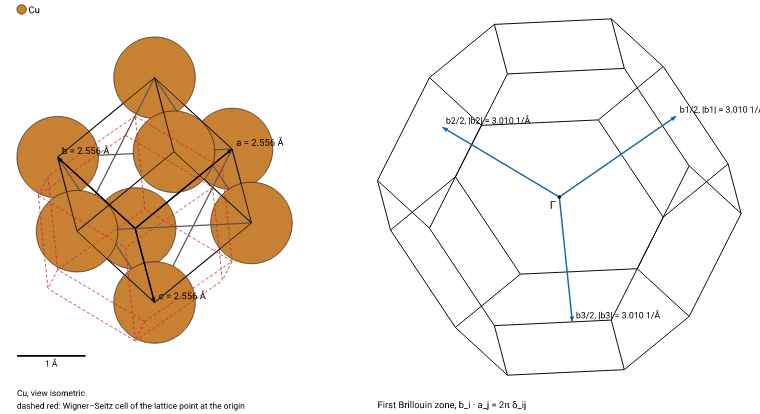
vibe-sketcher solid figure cu.vsk --structure cu --view isometric --wigner-seitz --brillouin -o fcc.svg: the fcc Wigner–Seitz cell (a rhombic
dodecahedron) and the first Brillouin zone (a truncated octahedron).
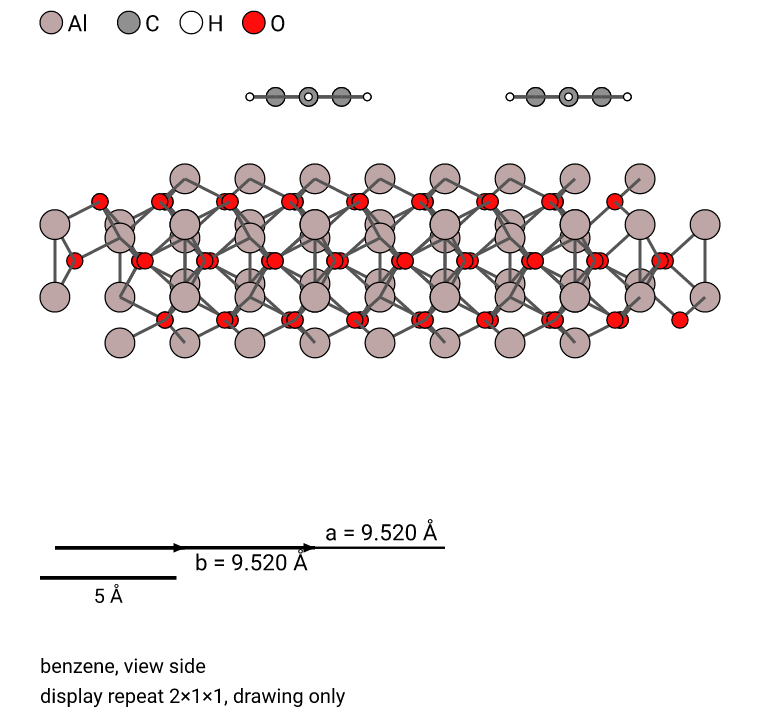
--view side --repeat 2,1,1 on the benzene/Al₂O₃(0001) slab.
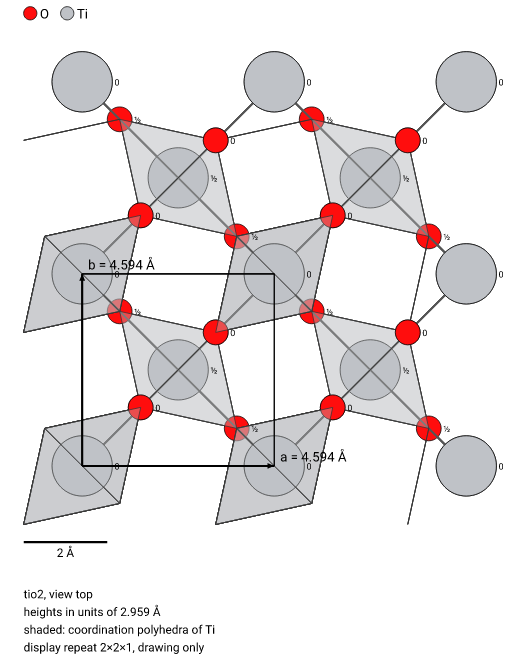
vibe-sketcher solid figure tio2.vsk --structure tio2 --view top --repeat 2,2,1 --heights --polyhedra Ti -o rutile.svg: edge-sharing TiO₆ octahedra, with
heights in units of c = 2.959 Å.
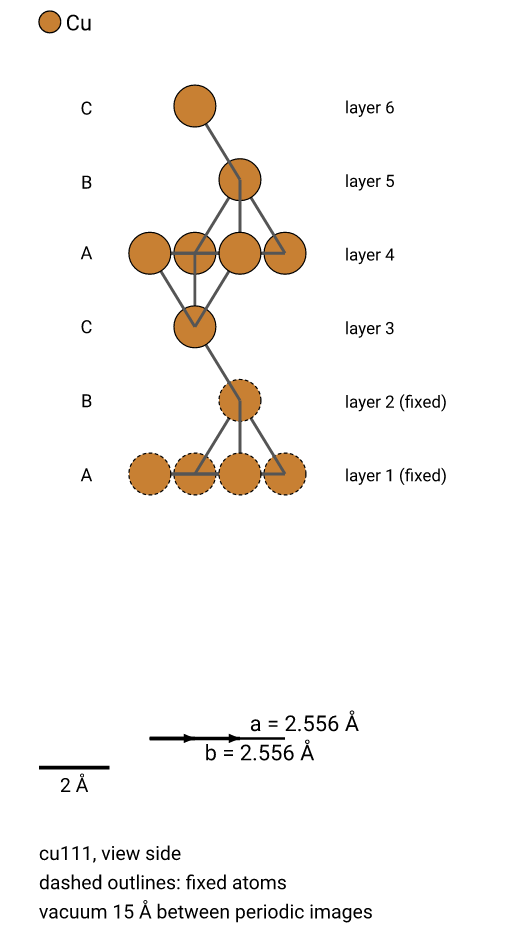
--view side --layers --stacking on a six-layer Cu(111) slab with two fixed
layers: the ABC stacking of a face-centred cubic metal.
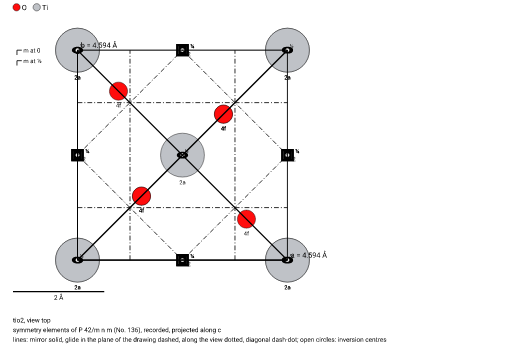
vibe-sketcher solid figure tio2.vsk --structure tio2 --view top --symmetry-elements --labels wyckoff --no-bonds -o p42mnm.svg: the symmetry
elements of P4₂/mnm projected along c, with Ti on 2a and O on 4f.
Adsorption, surface and defect energies
solid energy plan (REST POST /api/documents/{id}/periodic/energy/plan,
MCP plan_solid_energy) fixes the members of an energy difference. It writes
one vibe-qc input per member with the same Hamiltonian, plus the plan
(KIND-plan.json), which records the formula, the normalisation and every
assumption. solid energy evaluate (REST POST /api/periodic/energy/evaluate,
MCP evaluate_solid_energy) reads each member’s result QVF. It checks that
the run converged, that its composition is the planned structure’s and that
its method is the planned one, then returns the energy. A gas-phase molecule
is computed as a molecule with the same method and basis; SECCM members pair
with molecular MSINDO.
Kind |
Formula |
Members |
Refused when |
|---|---|---|---|
|
E_ads = [E(slab + n X) − E(slab) − n E(X)] / n, in eV and kJ/mol |
|
the complex was not built on that slab, the cells differ, or the composition difference is not a whole number of X |
|
γ = [E(slab) − N E(bulk cell)] / (2A), in J/m² and eV/Ų |
|
the slab is not stoichiometric with identical faces, or not a whole multiple of the bulk cell |
|
E_f = E(defective) − E(pristine) − Σ Δn_i μ_i, in eV |
|
a reservoir is missing, or the defect is charged |
A reservoir is a stated value with its source (--reservoir O=-4.9@source) or
a gas species and its atom count (--reservoir O=o2/2, so μ_O = E(O₂)/2).
Charged defects are refused. They need a Fermi level, potential alignment
and a finite-size correction (Freysoldt, Neugebauer and Van de Walle 2009),
and the plan does not supply those rather than report an uncorrected number.
The plan records k-mesh, slab thickness, vacuum and cluster size but does not
converge them, and it uses geometries as built: relax them first.
vibe-sketcher solid energy plan ads.vsk --kind adsorption --complex benzene --slab slab \
  --gas m1 --model seccm --max-iter 1000 -o energy
vibe-sketcher solid energy evaluate energy/adsorption-plan.json \
  --result complex=complex-benzene-seccm.qvf --result slab=slab-slab-seccm.qvf \
  --result gas=gas-m1.qvf
For flat benzene drawn 3.0 Å above the three-layer α-Al₂O₃(0001) 2×2 slab, unrelaxed, the three SECCM/MSINDO runs (vibe-qc 0.18.12) give E_ads = +0.90 eV. That is repulsive at this fixed geometry, which is why the plan says to relax first.
vibe-qc inputs
vibe-sketcher solid input writes a Python script for one periodic structure.
Run it with vibeqc run NAME.py. The script lists the lattice rows and atoms
in angstrom and converts them to bohr with CODATA 2018. It builds a
vq.PeriodicSystem from lattice_vectors=[a1, a2, a3], which avoids any
row/column ambiguity. Four models are available:
Model |
What it runs |
Dimensions |
|---|---|---|
|
|
1D, 2D, 3D |
|
the semiempirical cyclic cluster model (MSINDO), closed-shell single points. The cell’s atoms are the cluster, and its periodic vectors are the translations: CCM1D, CCM2D or CCM3D. |
1D, 2D, 3D |
|
the ab initio cyclic cluster model, with an explicit |
3D (vibe-qc#1089 tracks 1D/2D) |
|
a periodic MACE single point, or with |
1D, 2D, 3D |
k-points are a PBC concept. --kmesh n1,n2,n3 gives a Γ-centred mesh by
default. --kmesh-kind monkhorst-pack gives the Monkhorst–Pack mesh, which
skips Γ for even meshes. Without --kmesh, the job is Γ-only. Nonperiodic
directions must stay at 1. A cyclic cluster samples the Brillouin zone through
the size of the cluster, so seccm and aiccm take no mesh. Use a
wigner_seitz_supercell for the cluster.
--mace positions adds a periodic MACE pre-optimisation before any model. It
keeps fixed the sites the slab builder marked (fixed_layers) and any
fixed_sites of the spec. --mace cell relaxes a 3D cell without fixed
atoms instead. The relaxed system goes straight into the main job. A cluster
model then uses the relaxed cell as its cluster. The model is named
explicitly (--mace-model, default medium-mpa-0). --accept-mace-license
records that you accept the academic licence of the weights; it is never set
for you. Without MACE installed, the script stops with vibe-qc’s installation
hint.
The writer refuses what vibe-qc cannot run, with a reason. Today that covers:
BIPOLE on a true 2D or 1D model;
AICCM below three dimensions;
open-shell or optimisation SECCM;
k-points on a cluster model;
an odd electron count for the stated multiplicity;
partial occupancies;
MACE cell relaxation with fixed atoms or below three dimensions.
--max-iter raises the SCF iteration budget; some SECCM slabs need about 1000
iterations. --spec spec.json takes a whole PeriodicJobSpec instead of the
options.
SECCM and AICCM are experimental in vibe-qc, and the scripts say so. A script that runs shows that the input is valid. It does not show convergence. Converge the k-mesh, cluster size, slab thickness and vacuum yourself.
In the browser
Choose Solid-state builder… from the command palette (Ctrl/Cmd+K). The panel has one form per step: crystal, framework (MOF), periodic nanotube, rolled nanotube, cell choice, slab, adsorbate, defects and vibe-qc input. Import ▸ MOF or nanotube cell… opens the same panel at the framework form. Each form adds a new periodic structure to the document through the same REST recipes. After a build, every source list moves to the new structure, so the steps chain without re-selecting. Adsorbates can come from a species drawn on the canvas or from SMILES. The preview shows a schematic top or side projection of the chosen structure, with its formula, its dimensionality and any warnings the builder recorded. It is an aid to orientation, not a 3D viewer; detailed 3D work stays in vibe-viewer. Download input saves the vibe-qc script. A request the writer refuses shows its reasons in the panel.
Below the preview, Edit the previewed structure fills in the current cell parameters for editing. Click atoms in the preview to select them; shift-click adds atoms. You can also select by element or slab layer, or choose the last adsorbate. Drag a selected atom to move the whole selection in the plane of the view (x, y from the top, x, z from the side), or type a translation and a rotation about the normal. Add layers grows a builder slab, and Show in vibe-viewer (3D) hands the structure over.
Command line
vibe-sketcher solid crystal mgo.vsk --id mgo --prototype rocksalt
vibe-sketcher solid cell mgo.vsk --source mgo --id mgo-conv --choice conventional
vibe-sketcher solid cell mgo.vsk --source mgo --id mgo-ws --choice wigner_seitz_supercell \
  --matrix 2,2,2
vibe-sketcher solid crystal tio2.vsk --id tio2 --bravais tP --a 4.594 --c 2.959 \
  --site Ti:0,0,0 --site O:0.3048,0.3048,0 \
  --op x,y,z --op -x,-y,z --op -y+1/2,x+1/2,z+1/2 --op y+1/2,-x+1/2,z+1/2 \
  --op -x+1/2,y+1/2,-z+1/2 --op x+1/2,-y+1/2,-z+1/2 --op y,x,-z --op -y,-x,-z \
  --cell conventional
vibe-sketcher solid wigner-seitz mgo.vsk --structure mgo
vibe-sketcher solid crystal al2o3.vsk --id al2o3 --prototype corundum --cell conventional
vibe-sketcher solid slab al2o3.vsk --source al2o3 --id slab --miller 0,0,1 --layers 3 \
  --repeat 2,2 --fixed-layers 1
vibe-sketcher solid adsorb al2o3.vsk --source slab --id benzene --smiles c1ccccc1 --height 3.0
vibe-sketcher solid defect al2o3.vsk --source slab --id vac --vacancy O1 --charge 0
vibe-sketcher solid edit-cell al2o3.vsk --structure slab --vacuum 20
vibe-sketcher solid move al2o3.vsk --structure benzene --adsorbate 0 --by 0,0,0.2 --rotate 30
vibe-sketcher solid add-layers al2o3.vsk --structure benzene --count 2
vibe-sketcher solid view al2o3.vsk --structure benzene
vibe-sketcher solid input mgo.vsk --structure mgo --method pbe --basis pob-tzvp --kmesh 4,4,4
vibe-sketcher solid input mgo.vsk --structure mgo-ws --model seccm --method msindo
vibe-sketcher solid input mgo.vsk --structure mgo --model aiccm --variant four-center \
  --extension 2,2,2
vibe-sketcher solid input al2o3.vsk --structure benzene --method pbe --mace positions
vibe-sketcher solid nanotube cnt.vsk --id cnt --armchair 10 --periods 4
vibe-sketcher solid nanotube cnt.vsk --id dwnt --armchair 5 --outer-wall 10,10
vibe-sketcher solid nanotube cnt.vsk --id chiral --chirality 6,3
vibe-sketcher solid crystal bn.vsk --id bn --prototype hbn
vibe-sketcher solid roll bn.vsk --source bn --id bnnt --chirality 10,10 --indices nanotube
vibe-sketcher solid framework mof.vsk --id mof5 --node zn4o --linker bdc
vibe-sketcher solid framework mof.vsk --id irmof8 --node zn4o \
  --linker-smiles 'OC(=O)c1ccc2cc(C(=O)O)ccc2c1'
vibe-sketcher solid framework mof.vsk --id dmof --node paddlewheel --metal Zn \
  --linker bdc --pillar dabco
The solid crystal, solid nanotube and solid framework commands create the
document when it does not exist yet.
solid build DOCUMENT --recipe recipe.json applies any recipe written as JSON.
Python
from vibesketcher.document import new_document
from vibesketcher.document.solid_build import CellRecipe, CrystalRecipe, build

doc = build(new_document(), CrystalRecipe(identifier="al2o3", prototype="corundum"))
doc = build(doc, CellRecipe(identifier="al2o3-hex", source="al2o3", choice="conventional"))
The lower-level functions live in vibesketcher.document.crystal:
prototype, build_crystal, primitive_cell, wigner_seitz_cell and
wigner_seitz_polyhedron. NanotubeRecipe, RolledNanotubeRecipe and
FrameworkRecipe build periodic nanotubes and frameworks the same way. Their
builders are vibesketcher.chem.nanotube_cells.build_nanotube_cell,
vibesketcher.chem.rolled_tubes.roll_layer and
vibesketcher.chem.frameworks.build_framework.
REST and MCP
POST /api/documents/{id}/periodic/buildtakesrevisionandrecipe.GET /api/documents/{id}/periodic/{structure}/wigner-seitzreturns the polyhedron.GET /api/periodic/prototypeslists the library.POST /api/documents/{id}/periodic/import-ciftakesrevision,text,identifierand the import options; the MCP tool isimport_cif.POST /api/documents/{id}/periodic/import-bcs(text,identifier),GET /api/documents/{id}/periodic/{structure}/bcsandPOST /api/documents/{id}/periodic/transform-setting(source,identifier,transformation); the MCP tools areimport_bcs,export_bcsandtransform_setting.GET /api/periodic/templates?query=&category=searches the crystal templates; acrystalrecipe takestemplatewith optionalaandc.A
slabrecipe takestemplate(withtemplate_a,template_c) instead ofsource, andallow_polar.GET /api/periodic/templates/{name}/terminations?miller=1,1,0&layers=1andGET /api/documents/{id}/periodic/{structure}/terminations?miller=preview the terminations; the MCP tool isslab_terminations.POST /api/documents/{id}/periodic/edittakesrevisionandedit(kindsedit_cell,move_sites,set_sites,add_layers), andGET /api/documents/{id}/periodic/{structure}/cellreturns the cell parameters.GET /api/periodic/frameworkslists the framework nodes, linkers and pillars.GET /api/documents/{id}/periodic/{structure}/symmetry?symprec=0.001returns the space-group report, or 503 without thesymmetryextra.POST /api/documents/{id}/periodic/{structure}/inputtakesspecand returns the files, or 422 with the refusal reasons.
The MCP tools build_periodic, wigner_seitz, periodic_prototypes,
periodic_frameworks, periodic_templates, periodic_symmetry, write_periodic_input,
edit_periodic and view_periodic call these routes. In Python, use
vibesketcher.inputs.vibeqc_periodic.write_periodic_input(structure, spec), and
vibesketcher.document.solid_edit for the edits.