

Reticular frameworks: building blocks on explicit nets
This tutorial assembles four frameworks from drawn building blocks: a diamondoid polyphenylene, two frameworks on the chiral srs net, and a kagome layer with a four-connected metal node. It shows what the builder checks and how it refuses a block that does not fit.
You need vibe-sketcher. The commands write mof.vsk in an empty directory.
The reference is Reticular frameworks.
1. The nets
vibe-sketcher solid nets
pcu	3D	6-c	primitive cubic: 6-c octahedral vertex, one vertex per cell
dia	3D	4/4-c	diamond: 4-c tetrahedral vertices, two per primitive fcc cell
sql	2D	4-c	square grid layer: 4-c square-planar vertex, one per cell
hcb	2D	3/3-c	honeycomb layer: 3-c trigonal vertices, two per hexagonal cell
kgm	2D	4/4/4-c	kagome layer: 4-c vertices where two straight lines cross at 60 degrees, ...
srs	3D	3/3/3/3-c	the chiral 3-c net of I4_132 (Laves graph, K4 crystal): ...
gated	interpenetration, rod_nodes, merged_nets, partitioned_pores, supertetrahedral_units
Each net is written out from its lattice geometry with unit edges; the names follow the RCSR, but no RCSR data is bundled. The last line lists extensions that are refused by name until they are designed.
2. A connection point is a marker
A building block is a molecule whose connection points are marked: * in
SMILES, X in an explicit atom list, or the R-group atoms of a drawn
generic structure. Each marker is bonded to one anchor atom. Markers are
never atoms of the framework: the anchors are bonded across the net’s edges.
Check an assembly before storing it with --preview:
vibe-sketcher solid reticular mof.vsk --id dia-ph --net dia --node "[*]C([*])([*])[*]" --linker "[*]c1ccc([*])cc1" --linker-rotation 45 --preview
The JSON report counts everything: 2 vertices and 4 edges, 8 connections
expected and made, 42 atoms expected and placed, 16 markers removed and none
left in the structure. Without --preview the framework is stored:
vibe-sketcher solid reticular mof.vsk --id dia-ph --net dia --node "[*]C([*])([*])[*]" --linker "[*]c1ccc([*])cc1" --linker-rotation 45
A tetrahedral carbon sits on each diamond vertex and a p-phenylene on each
edge. --linker-rotation turns the linkers about their edges; at 0 degrees
their hydrogens clash, and the build is refused with assembly.collision.
3. The chiral srs net
vibe-sketcher solid reticular mof.vsk --id srs-ph --net srs --node "[*]c1cc([*])cc([*])c1"
vibe-sketcher solid reticular mof.vsk --id srs-yne --net srs --node "[*]c1cc([*])cc([*])c1" --linker "[*]C#C[*]"
vibe-sketcher solid figure mof.vsk --structure srs-ph --view uvw --direction 1,1,1 --repeat 2,2,2 --no-cell -o srs-111.svg
srs has four planar three-connected vertices per primitive cell, each twisted against its neighbours, so the shortest rings have ten vertices. A 1,3,5-benzenetriyl node fits each vertex. Joined directly they give a polyphenylene (C24H12 per cell); with an ethynylene on every edge, an expanded framework (C36H12). Viewed along a three-fold axis, the frameworks show their three-fold symmetry. The net is chiral; the catalogue holds the I4₁32 hand.
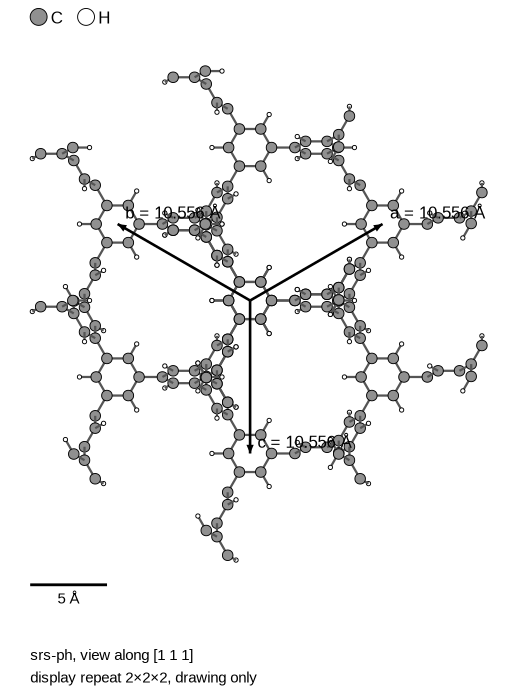
The srs polyphenylene, viewed along [111].
4. A kagome layer from an explicit metal node
The kgm vertex is two straight lines crossing at 60 degrees. A block for
it can be written out atom by atom: download
kagome-node.json, a platinum atom
with four X markers in its plane at 0, 60, 180 and 240 degrees.
vibe-sketcher solid reticular mof.vsk --id kgm-pt --net kgm --node-atoms kagome-node.json --linker "[*]C#C[*]"
vibe-sketcher solid figure mof.vsk --structure kgm-pt --view top --repeat 3,3,1 -o kgm-pt.svg
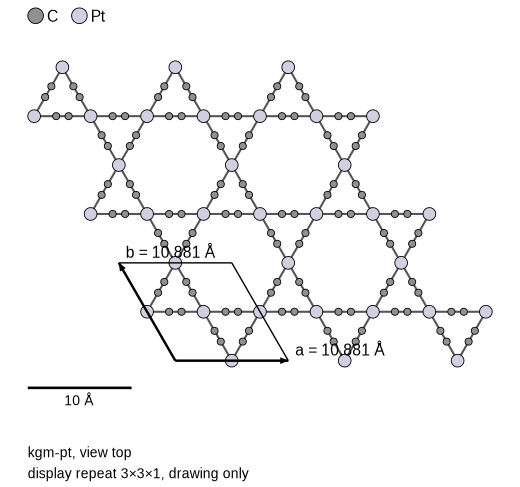
Platinum nodes and ethynylene linkers on the kagome net.
A layer net gets 15 Å of vacuum over its thickest atom (--vacuum).
5. A block that does not fit
The builder matches each node’s connection directions to its vertex by the best proper rotation, and refuses a misfit rather than bending the block. A three-connected node on the four-connected square net is refused at once:
$ vibe-sketcher solid reticular mof.vsk --id bad --net sql --node "[*]c1cc([*])cc([*])c1" --preview
site.coordination_mismatch
Other refusals have stable codes too: site.direction_mismatch for a node
whose directions are further off than --angle-tolerance (20 degrees by
default), assembly.collision for atoms closer than --min-distance, and
assignment.second_node for a second node on a net without two vertices.
See Refusals.
Inspect the result
vibe-sketcher solid graph mof.vsk --structure srs-ph
The net’s edges are stored as topology edges, separate from the chemical
bonds, so the framework’s connectivity stays visible:
srs-ph: edges authored 42, topology 6
  fragment 0: C24H12 framework
The structure is an unrelaxed starting geometry. Write a periodic vibe-qc
input with solid input, or relax it with a MACE stage first
(solid-state inputs).
Where to go next
The same builds run from Python: see the reticular example.
REST:
POST /api/documents/{id}/periodic/reticular/previewand.../periodic/build; MCP:periodic_nets,preview_reticularandbuild_periodic.